
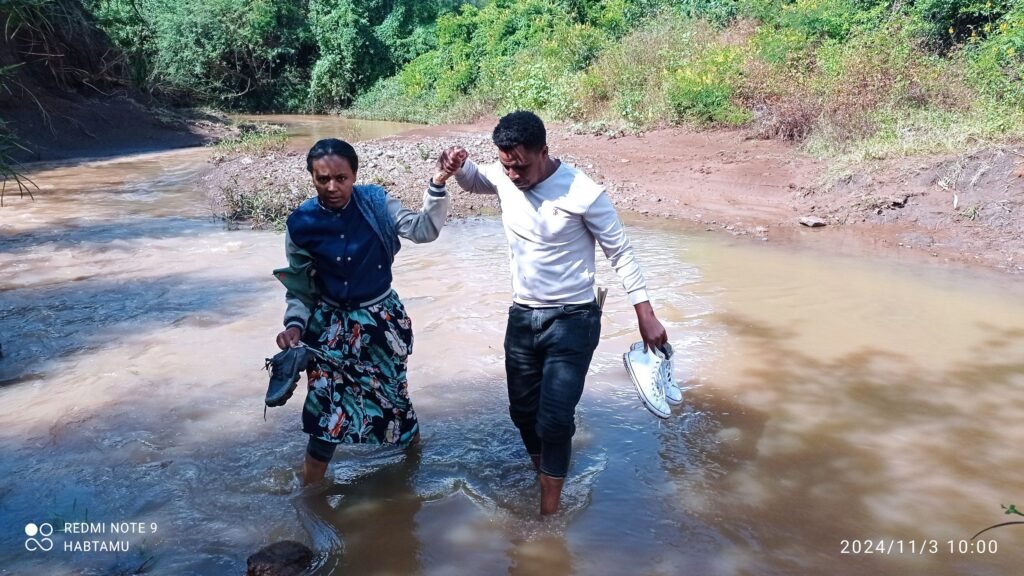
Location: Ethiopia, Amhara Region, Mogedel Watershade
Credit: Habtamu Assaye
Initiative: APPEAR/OeAD (Austrian Development Cooperation (ADC))
Project: Project351: Establishing Transformative Learning, Research, and Community Outreach and Capacities in Agroecology at Bahir Dar University, Ethiopia
Story: This photo captures a moment of commitment, resilience, and service during the implementation of the APPEAR LINK Project in rural Ethiopia. The image shows project team members crossing a river on foot while traveling to remote communities that are difficult to access by road. The journey was part of a field mission to identify and support vulnerable women farmers for inclusion in Farmers Family Learning Groups (FFLGs).
The communities visited are located in isolated rural areas where access to extension services, markets, and livelihood opportunities remains limited. During the rainy season, rivers overflow, and transportation becomes extremely challenging. Despite these difficulties, the project team continued traveling from village to village to ensure that disadvantaged women were not left behind.
The purpose of the visit was to select poor female-headed households and vulnerable women farmers who would receive livelihood support through sheep and poultry production activities. These interventions were designed to improve household income, strengthen food security, and enhance women’s participation in local economic activities. Through the Farmers Family Learning Groups approach, women also gain opportunities to share experiences, learn improved farming and animal husbandry practices, and build social support networks within their communities.
Beyond the physical journey shown in the photo, the image represents the broader reality faced by many rural development practitioners and communities in remote parts of Ethiopia. It highlights both the infrastructural challenges rural people face daily and the determination required to deliver inclusive development support. The crossing symbolizes more than movement across water—it reflects the effort to bridge gaps in opportunity, access, and social inclusion.
The societal impact of such initiatives is significant. Supporting vulnerable rural women with sustainable livelihood options contributes to poverty reduction, household resilience, nutrition improvement, and community empowerment. The photo, therefore, tells a story not only of hardship and distance but also of hope, dedication, and the shared commitment to creating lasting change in underserved rural communities.