
Location: Ethiopia, South Omo Valley, Tirga
Credit: Simon Bunchuay-Peth
Initiative: Belmont Forum CRAs (CCH 2023)
Project: Cultural Heritage in Motion (CuHeMo)
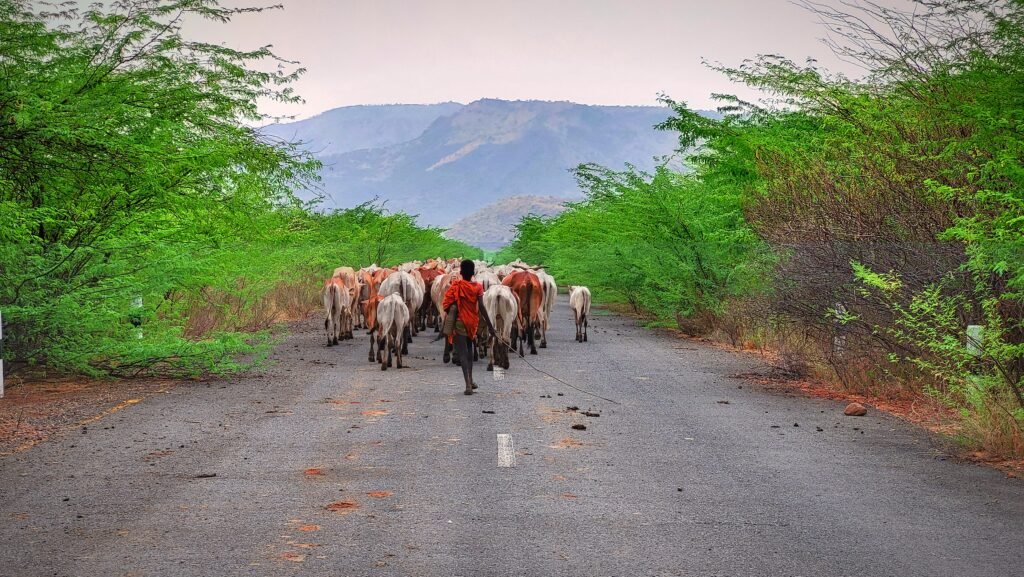
Story: On the road to the Tirga mountains in the Lower Omo Valley of southern Ethiopia, a young Nyangatom herder guides his cattle forward. What looks, at first glance, like a usual pastoral scene is, on closer inspection, a landscape of accumulated pressures, each element in the frame telling part of a larger story of disruptions, adaptation, and resilience.
The road itself was not built for the herders. It was constructed to service a large-scale sugar cane plantation, one of several industrial agricultural projects that have fundamentally transformed the Lower Omo Valley over the past two decades, encroaching on the grazing lands the Nyangatom, a semi-nomadic agro-pastoralist community, have depended on for generations. For the plantation’s trucks, the road is a supply line. For the Nyangatom herder, it has become a corridor of last resort.
On both sides, dense thickets of Prosopis juliflora, an invasive shrub introduced to the Horn of Africa decades ago, have colonized the landscape. What was once open savannah and pastoral land is now a tunnel of thorns. Prosopis not only encroaches on the native grassland that sustains cattle; it physically walls off the traditional migration routes that have shaped Nyangatom mobility and cultural heritage for centuries. The herder walks the asphalt because the paths his ancestors walked are no longer passable.
And yet, the road also brings connection. With it come markets, information, medical services, but also new vulnerabilities: outside influences that reshape livelihoods and cultural practices with a speed that leaves little room for cultural adaptation.
This photograph was taken during fieldwork for CuHeMo (Cultural Heritage in Motion), a transdisciplinary research project funded under the Belmont Forum Collaborative Research Action on Climate and Cultural Heritage. CuHeMo examines how indigenous communities with historically mobile livelihoods navigate the intersection of climate change, cultural heritage, and top-down sedentarization. In the Nyangatom case, it is not climate variability alone that threatens mobile cultural heritage; it is the layered pressures of industrial land use, biological invasion, and infrastructural transformation, compounding one another in ways that no single discipline can fully capture.
What this image holds, in a single frame, is the central paradox of the Nyangatom situation: still moving but with every step, the space to move narrows.