
Location: Argentina, Chaco Province, Bermejo Department, Paraje Tres Horquetas
Credit: M.Florencia Fossa Riglos
Initiative: JPI CLIMATE-BF 2015 (JPI CLIMATE – Belmont Forum )
Project: CLIMAX
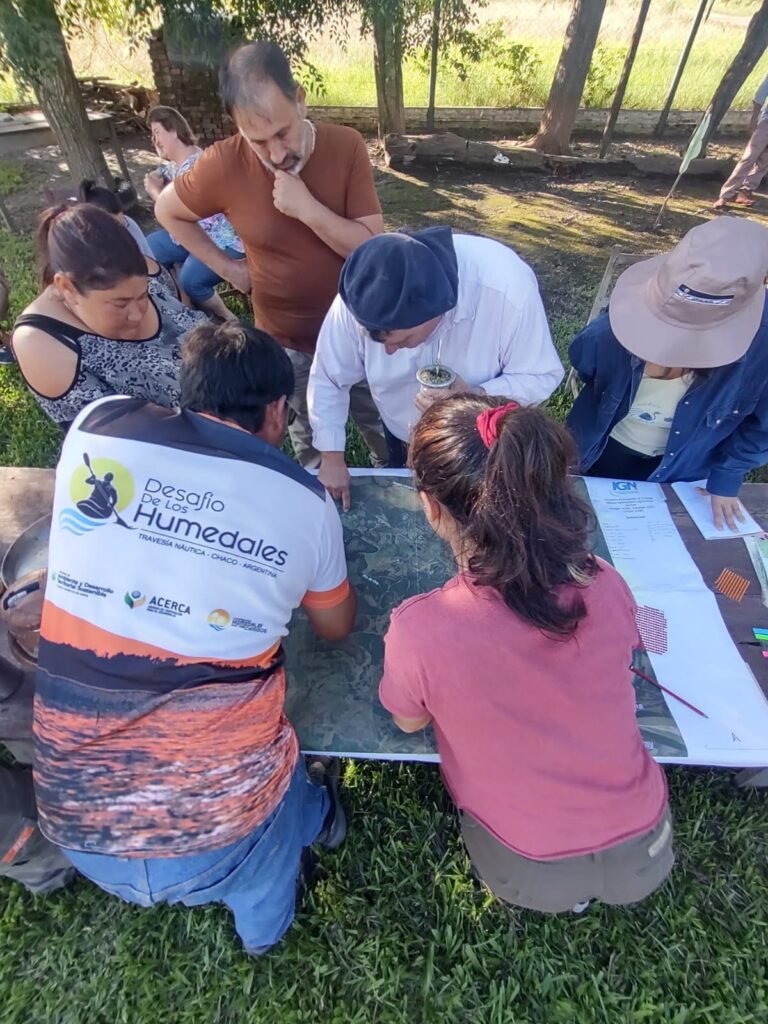
Story: This photograph also captures a mapping workshop for flood risk management held on the farm of a family farmer in Tres Horquetas, a rural locality in Bermejo Department, Chaco Province, Argentina. The activity was part of the coproduction process carried out by the CLIMAX project between 2016 and 2023 (in collaboration with Argentina’s National Geographic Institute and Anticipando la Crecida project). Around twenty people participated in the mapping exercise, including academic actors (climatologists, anthropologists, a veterinarian, and an agronomist) from scientific institutions in Argentina and France, small and medium scale family farmers, and public policy decision makers involved in adapting the agricultural sector to climate change.
This image focuses on the practical work of interpreting and annotating the map. Participants gather around a large satellite image spread across a table, identifying and discussing key spatial features. The process combines observation, dialogue, and systematic documentation: rivers, wetlands, roads, productive areas, settlements, and flood-prone zones are marked with colored stickers and accompanied by written notes. These visual markers allow different categories of information to be collectively organized, discussed, and validated.
Several elements highlight the strong territorial embeddedness of the activity. A local farmer wears a shirt displaying the words “Desafío de los Humedales” (Wetlands Challenge), referring not only to the environment being mapped but also to tourism initiatives developed in the region with support from provincial public institutions. The shirt reflects the multiple values associated with the territory, linking environmental conservation, local livelihoods, recreation, and rural development. The green landscape visible in the background shows that the territory under discussion is not an abstract object of analysis but the lived environment of participants. The presence of mate, a culturally significant South American infusion shared during the workshop, further reflects the socio-cognitive relationships built over the years of the CLIMAX project.
The photograph also documents a process through which different forms of knowledge interact under conditions of cognitive symmetry (Hernández et al., 2022). Through dialogue and mutual learning, abstract cartographic information is transformed into a meaningful representation of places, resources, environmental risks, and socio-territorial dynamics. The resulting collaboration generated a complex understanding of hydroclimatic risks and socio-territorial challenges (multidimensional, multiscalar, and spanning multiple temporalities) coproducing a map with socially relevant markers (informal bridges, shortcuts, natural indicators of river flood levels), which strengthened local capacities for climate change adaptation and informed public policy decision-making.