
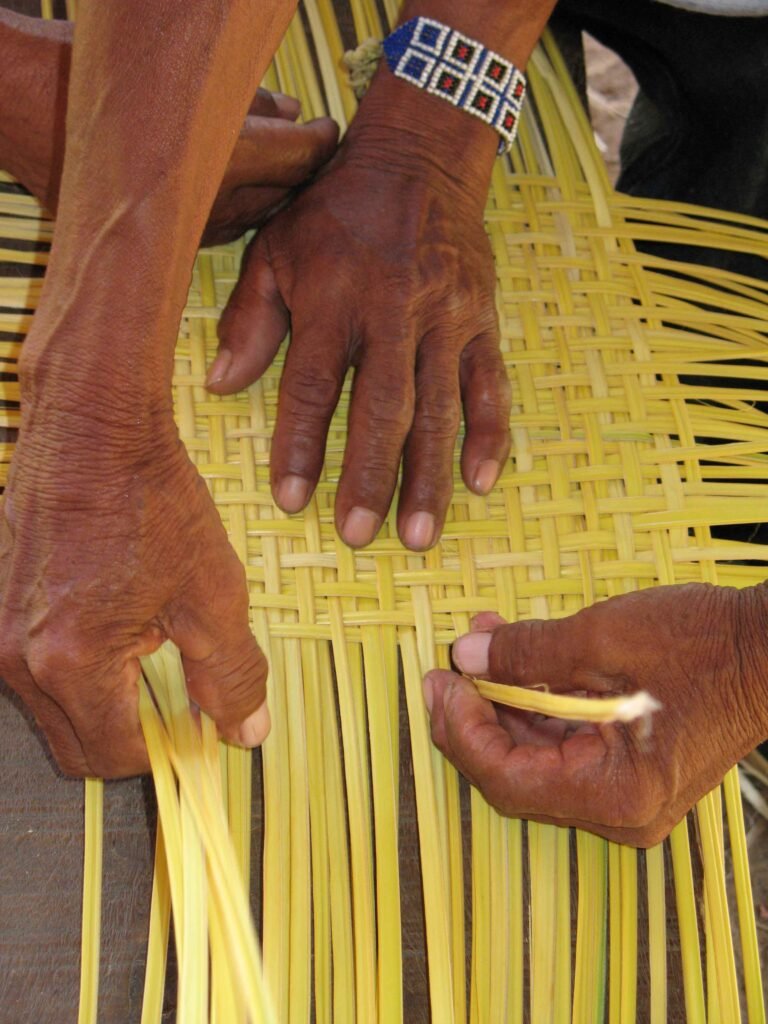
Location: Tuiarare Village, Xingu Indigenous Territory, Brazilian Amazon
Credit: Simone Athayde
Initiative: Community-based project, part of Rainforest Foundation Norway (RFN – Rainforest Foundation Norway, formerly funded by PPG& Pilot Projects)
Project: Weaving Power: Biocultural resilience through artistic knowledge in the Brazilian Amazon
Story: This photograph was taken during a community-based weaving workshop with the Kawaiwete/Kaiabi people in the Brazilian Amazon, as part of the Kaiabi Araa project, meaning “Kaiabi basketry symbols.” The project was co-led by Indigenous leaders and Simone Athayde to revitalize basketry and textile knowledge, strengthen intergenerational learning, and support the sustainable management of biodiversity used in cultural objects.
In the image, several hands work together to weave strands of arumã fiber into a basket. The scene is simple, but it carries a deeper story. Each strand remains visible and distinct, yet the basket only takes shape through careful interlacing, coordination, and shared intention. For me, this is a powerful metaphor for transdisciplinary knowledge production. Different knowledge systems do not need to merge into one or lose their identity. Like the strands in the basket, Indigenous, academic, artistic, ecological, historical, and spiritual knowledges can remain grounded in their own integrity while contributing to something collective and new.
The workshop created a space for “many-to-many” learning, where elders, teachers, youth, men, and women exchanged knowledge across generations and territories. It also supported the visual repatriation of basketry designs from national and international ethnographic museum collections, helping younger generations recover, reinterpret, and re-create artistic knowledge. The project generated educational materials for villages, academic publications co-authored with Indigenous leaders and researchers, a documentary video, awards, and renewed pathways for cultural transmission.
The basket also symbolizes biocultural resilience. Kawaiwete weaving is not only an artistic practice; it carries memory, identity, cosmology, ecological knowledge, and relationships with plants and landscapes. Revitalizing weaving knowledge therefore also means revitalizing relationships among people, territories, biodiversity, and ancestral teachings.
The spirit of this photo resonates with Indigenous philosophies of braiding, threading, and “two-eyed seeing,” in which different ways of knowing work together without hierarchy. It reminds us that transdisciplinarity is not only a research method, but a relational practice: patient, embodied, collaborative, and grounded in respect. Like a basket woven by many hands, meaningful knowledge for sustainability emerges through connection, without erasing the diversity of the strands that make the whole strong, beautiful, and alive.