
Location: Kathoda Village, Beed Block and District, Marathwada Region, Maharashtra, India
Credit: Swati Satpute
Initiative: Agroecology Independent funding (Bharat Agroecology Fund, India)
Project: Strengthening food and soil systems through Ecologically Sound Self-Reliant Farming (ESSRF) led by women farmers
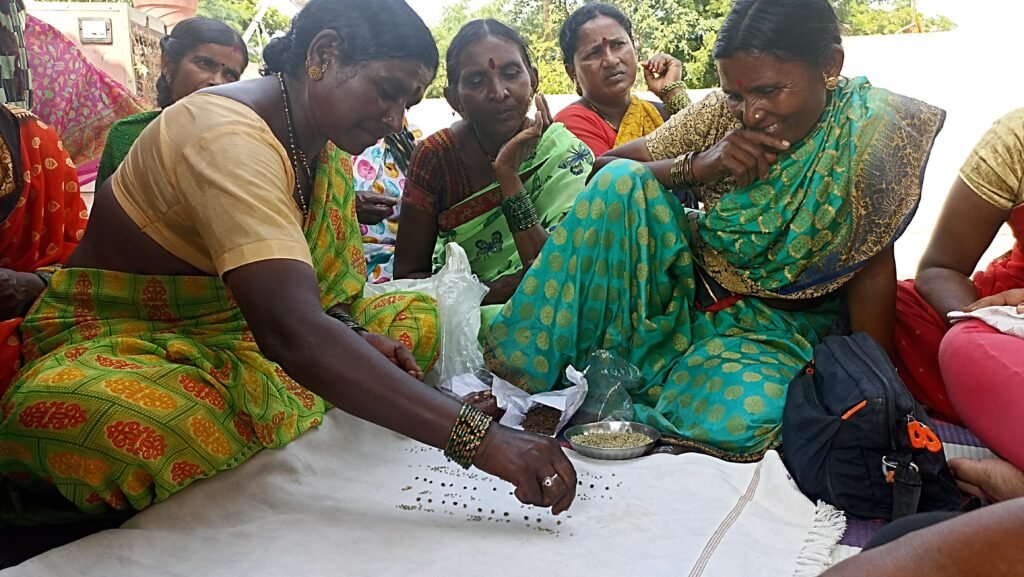
Story: This photograph captures a powerful moment of learning, leadership, and collective wisdom among women farmers who are part of an agroecology-based, self-reliant farming initiative in Kathoda village, Maharashtra. At the centre of the image, Dwarka Waghmare a champion woman farmer, spread a seed on the cloth and explaining how in a mixed cropping pattern different crops can be grown together to improve soil health, increase biodiversity, and strengthen food security. The scene captures a powerful moment of farmer-to-farmer learning, where knowledge is exchanged through experience, observation, and collective discussion.
Dwarka is part of an agroecology-based, self-reliant farming initiative based on biodiversity, local seeds, and locally available resources. Mixed cropping is one of the key approaches used to improve soil health, reduce pest and disease pressure, increase resilience to climate variability, and ensure diverse food production throughout the year. Through regular meetings, field demonstrations, and peer learning processes, women farmers exchange practical knowledge and develop solutions that are rooted in their local ecological conditions.
Beyond the technical aspects of farming, this image highlights the important role of women as knowledge holders, educators, and community leaders. In many rural communities, women’s agricultural knowledge has often remained invisible and undervalued despite their central role in farming. Agroecology-based, self-reliant farming initiatives are creating spaces where women can share their expertise, gain confidence, and receive recognition for their contributions to agriculture.
The societal impact of these processes extends far beyond agricultural production. As women strengthen their knowledge, confidence, and leadership skills, they play a greater role in household decision-making, community leadership, and local food systems. Through farmer-to-farmer learning, they become sources of knowledge and inspiration for other farmers, encouraging the adoption of sustainable farming practices across their communities.
For many Dalit women farmers, agroecology is also a pathway to visibility, recognition, and social empowerment. Despite their long-standing contribution to agriculture, they have often been viewed as agricultural labourers rather than farmers and decision-makers. By leading discussions, sharing expertise, conserving local seeds, and making informed decisions about their farms, women like Dwarka Waghmare are challenging traditional barriers of caste and gender. As their knowledge and leadership gain recognition within their families and communities, they are building stronger identities as farmers in their own right. This image captures a powerful moment in that transformation—one where local knowledge is valued, women’s voices are heard, and farming becomes a source of dignity, confidence, and social change.