
Location: Basamba Village, Hingoli Taluka and District, Maharashtra, India
Credit: Swati Satpute
Initiative: Agroecology Independent funding (American Jewish World Centre, USA (AJWS))
Project: Women farmers lead the way: pathways for climate resilient farming in Maharashtra, implemented by Society for Promoting Participative Ecosystem Management (SOPPECOM) in collaboration with MAKAAM
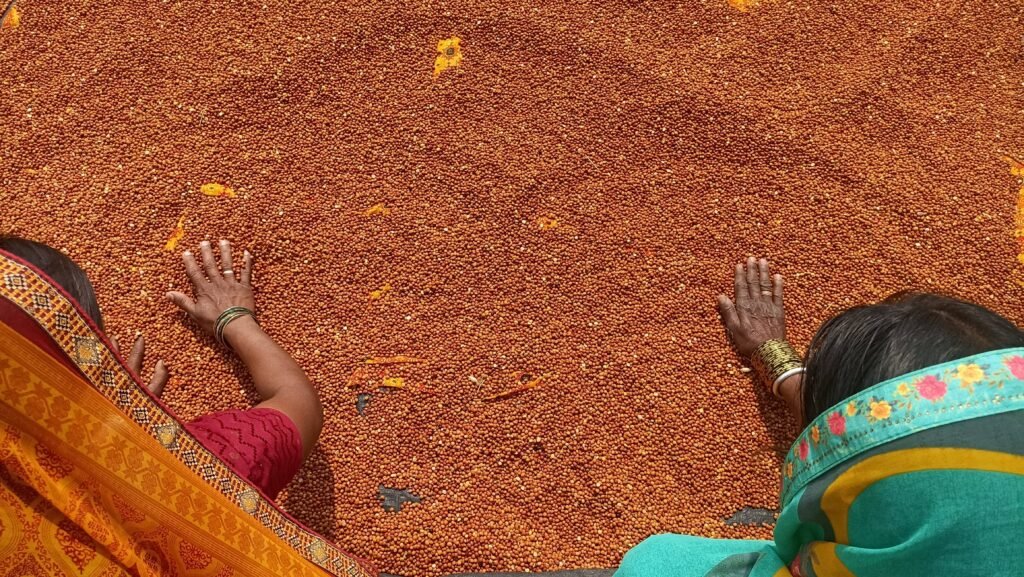
Story: This photograph captures women farmers drying seeds harvested from their agroecological farms as part of a self-reliant farming initiative in Maharashtra, India. The image was taken during a field visit while the women were carrying out their regular seed-processing work. As they spread the seeds under the sun, they work together and help one another, reflecting the spirit of cooperation and mutual support that is central to their farming practices.
These women are part of an agroecology-based farming initiative that has been implemented for several years across the Vidarbha and Marathwada regions of Maharashtra. The initiative promotes biodiversity, local seed conservation, and ecological farming practices that reduce dependence on costly external inputs. Women farmers cultivate a diverse range of crops, including cereals, pulses, oilseeds, vegetables, and traditional varieties, using locally available resources and agroecological methods. The initiative currently involves hundreds of women farmers who are working towards building self-reliant and sustainable farming systems.
Seed conservation is a key part of this process. By selecting, drying, storing, and saving their own seeds, women farmers protect local biodiversity and ensure that locally adapted seed varieties remain available for future generations. The seeds shown in this photograph represent not only the next crop cycle but also generations of knowledge, experience, and care. Through this work, women are preserving traditional seed varieties that are increasingly disappearing from rural farming landscapes.
The initiative has strengthened women’s control over the seeds and food produced on their farms. By saving their own seeds, they ensure access to diverse, nutritious, and chemical-free food for their families while reducing dependence on purchased seeds. The abundance of seeds in this photograph reflects the value of women’s labour and their contribution to household food security. The practice of seed saving has also helped revive traditions of sharing and mutual support within rural communities. Women exchange seeds, knowledge, and farming experiences, strengthening community relationships and collective resilience. Through agroecological farming, they are not only conserving biodiversity but also inspiring other farmers to adopt sustainable alternatives to chemical-intensive agriculture.
This image tells a story of women safeguarding the foundation of farming. Through their labour, knowledge, and collective action, they are protecting seed sovereignty, strengthening food security, and building a more resilient and sustainable future for their families and communities.