
Location: Tirzada Village, Yavatmal District, Vidarbha Region, Maharashtra, India
Credit: Vidya Kulkarni
Initiative: Agroecology funding (Agroecology Fund (AEF), USA)
Project: Women farmers show the way: consolidating the agroecological model in five districts of Maharashtra. Implemented by Society for Promoting Participative Ecosystem Management (SOPPECOM) in collaboration with MAKAAM
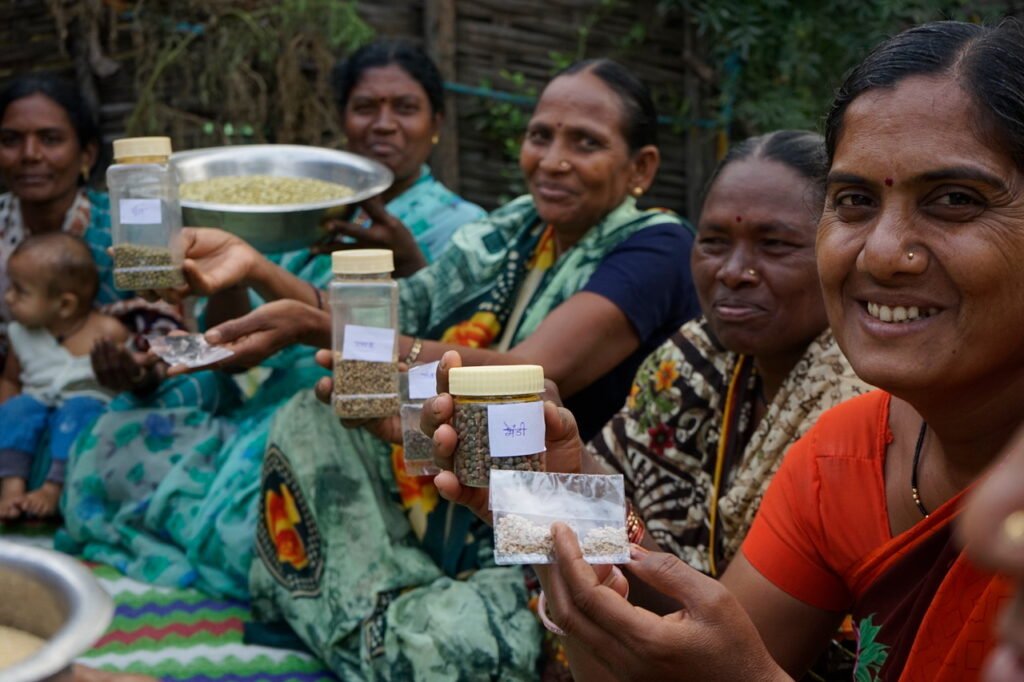
Story: This photograph captures a group of women farmers from Tirzada village displaying seeds that they have carefully conserved, multiplied, and harvested from their own farms. The collection includes locally adapted varieties of soybean, pigeon pea (tur), pearl millet (bajra), mung bean, black gram (urad), vegetables, and biomass-generating crops such as ambadi and boru. Each seed represents generations of farmer knowledge, adaptation, and stewardship.
The women are part of the Ecologically Sound Self-Reliant Farming (ESSRF) initiative, which supports women farmers in drought-prone regions of Maharashtra to build resilient and low-cost farming systems based on agroecological principles. Working on small plots of half to one acre, many women have transformed monocropped fields into biodiverse farms growing a wide range of food, fodder, pulse, vegetable, and cash crops. By conserving local seeds, preparing organic inputs, and practising mixed cropping, they are reducing dependence on costly external inputs while rebuilding soil fertility and farm resilience.
The significance of seed conservation extends beyond agriculture. In many farming households, women have traditionally been responsible for selecting, storing, and preserving seeds, yet their knowledge often remains unrecognised. Through collective meetings, field visits, record keeping, and seed exchanges, women are strengthening their role as decision-makers, innovators, and custodians of agricultural biodiversity. They regularly share seeds and farming experiences with one another, ensuring that locally adapted varieties continue to thrive despite increasing climate uncertainty.
The impact is visible both on farms and within communities. More than 200 women farmers across five districts have adopted agroecological practices through the initiative. Their farms are producing diverse and nutritious foods, cultivation costs have reduced, and local biodiversity is being restored. Women farmers are increasingly recognised as local resource persons, sharing knowledge on seed conservation, mixed cropping, and ecological farming with neighbours, schools, and other community members.