
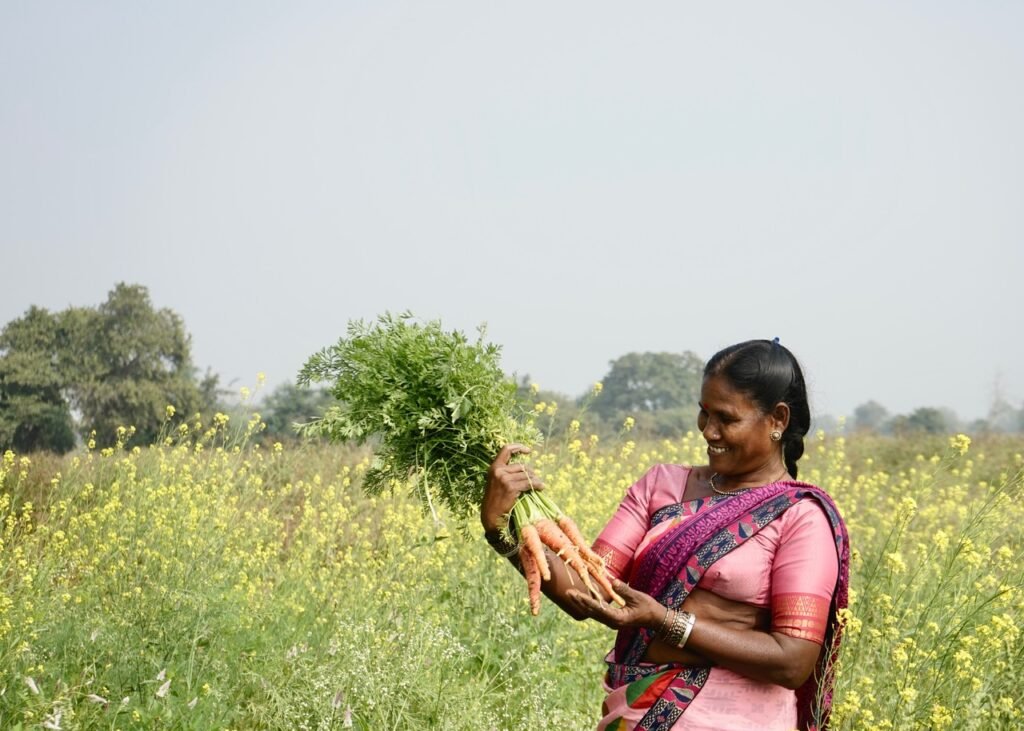
Location: Varud Village, Ralegaon Taluka, Yavatmal District, Maharashtra, India
Credit: Vidya Kulkarni
Initiative: Agroecology Funding (Progress for People in India, Seattle, USA)
Project: Women farmers lead the way: pathways for climate resilient farming in Yavatmal, Implemented by Society for Promoting Participative Ecosystem Management (SOPPECOM) in collaboration with MAKAAM
Story: This photograph shows Chanda Ghodam holding a harvest of organically grown carrots from her agroecological farm in Varud village, located in the drought-prone Vidarbha region of Maharashtra, India. Surrounded by fields of mustard and other crops, Chanda represents a growing movement of women farmers who are rebuilding agriculture through ecological and self-reliant farming practices.
Like many farmers in the region, Chanda faced the challenges of rising cultivation costs, climate uncertainty, and dependence on external agricultural inputs. Rather than continuing with conventional farming practices, she decided to experiment with agroecology. Her approach was simple: “Let me try—if it works, it works.”
Today, her entire farm is managed using agroecological principles. Instead of cultivating a single crop, she practices mixed cropping, growing grains, vegetables, coriander, tomatoes, oilseeds such as mustard and flax, and flowers on different plots. Crop residues, farm waste, goat manure, poultry manure, and other locally available resources are recycled back into the soil, reducing dependence on purchased inputs. Over time, Chanda and other women farmers have observed improvements in soil texture, moisture retention, crop diversity, and overall farm resilience.
These processes have strengthened women’s role in agricultural decision-making within households and communities. In Chanda’s case, visible improvements in soil quality, crop diversity, and reduced cultivation costs have helped shift perceptions within her family. Her husband and other family members, initially uncertain about the new approach, have become strong supporters of her farming decisions and leadership, reflecting how agroecology can contribute not only to ecological resilience but also to greater recognition of women’s knowledge and agency.
Chanda is one of more than 250 women across six districts of Vidarbha and Marathwada who are part of a movement for self-reliant farming. Together, they are conserving indigenous seeds, producing organic inputs, diversifying cropping systems, and improving household food security. By reducing cultivation costs and increasing access to diverse and nutritious foods, agroecological farming is helping women farmers build resilience while reclaiming control over how food is grown, shared, and consumed.