
Location: Zadgaon Village, Ralegaon Block, Yavatmal District, Vidarbha Region, Maharashtra, India
Credit: Vidya Kulkarni
Initiative: Agroecology Funding (Progress for People in India, Seattle, USA)
Project: Women farmers lead the way: pathways for climate resilient farming in Yavatmal, Implemented by Society for Promoting Participative Ecosystem Management (SOPPECOM) in collaboration with MAKAAM
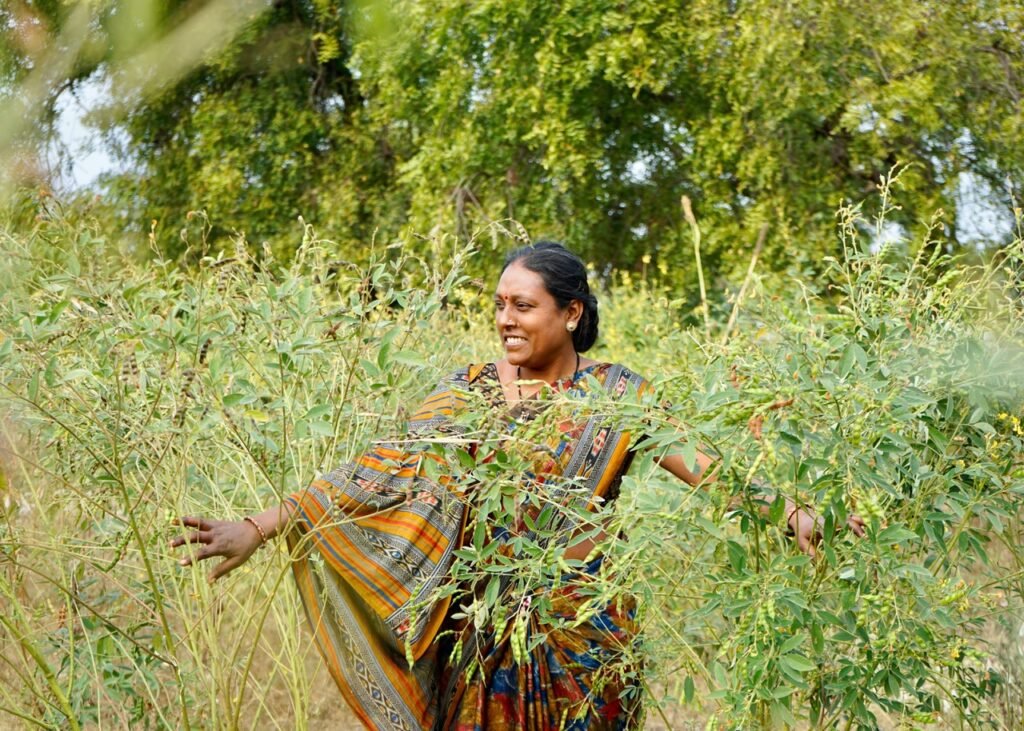
Story: This photograph captures Nilima Renghe in her agroecological farm in Zadgaon village in the drought-prone Vidarbha region of Maharashtra, India. Standing amidst a thriving field of pigeon pea (toor), she reflects the confidence and well-being that can emerge when farmers regain control over their farming systems.
Widowed in 2014 and left to raise her young son alone, Nilima fought for the right to cultivate three acres of family land. In 2020, she began experimenting with agroecological farming practices on a part of her farm. Instead of cultivating a single crop, she adopted mixed cropping, growing pigeon pea, mung bean, black gram, sorghum, vegetables, and other crops together. At a time when most neighbouring farms grew only cotton or soybean, her approach was viewed with scepticism. Family members and neighbours laughed at her “unusual” farming methods.
The first few years were challenging, but Nilima persisted. She observed improvements in soil fertility, reduced dependence on costly external inputs, and greater diversity in food available for her household. Over time, her farm became known locally for its productivity, biodiversity, and the taste of its naturally grown produce. Villagers now refer to such mixed cropping systems as “Colourful Farming” because of the diversity of crops growing together.
The impact extends beyond one farm. As a village-level leader associated with women’s farmer collectives, Nilima shares seeds, knowledge, and practical experience with other women farmers. Many have begun experimenting with similar methods, helping reduce cultivation costs, improve nutrition, conserve local crop diversity, and strengthen resilience to climate variability.
The photograph represents more than a successful harvest. It captures a broader transformation in which women farmers are emerging as innovators, custodians of biodiversity, and leaders of sustainable agricultural change. Nilima’s smile reflects not only personal achievement but also the hope, dignity, and well-being that agroecological farming can create for farming communities facing economic and environmental uncertainty.