
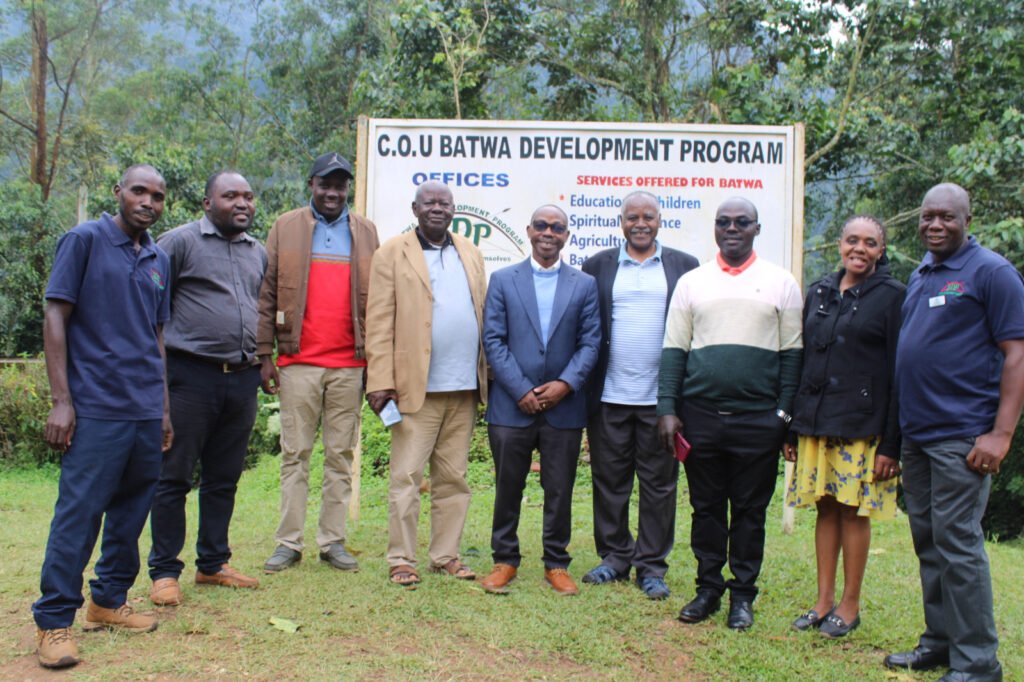
Location: Uganda, Kanungu District, at Batwa Development Program (BDP) Offices
Credit: Didacus Namanya
Initiative: Belmont Forum CRAs (CCH 2023)
Project: Indigenous Peoples Observatory Network (IPON) Complex Climate-Health Emergencies (CCHEs)
Story: The Indigenous Peoples Observatory Network (IPON) Complex Climate-Health Emergencies (CCHEs) aims to document, understand, monitor factors affecting the creation, evolution and impact Complex Climate-Health Emergencies among marginalized Indigenous Peoples in the Global South. This involves examining the interaction between climatic and non-climatic stressors, and co-generating knowledge and capacity to build resilience in health and food systems. Uganda is one of the 5 countries where this work is being undertaken. Others are; India, Peru, Bolivia, and Argentina.
In the photograph, the Uganda Team had just completed an initial meeting with the Batwa Development Program (BDP) officials to introduce the project and to discuss how it will be undertaken. The CCHEs project builds on prior research and engagement with the Batwa IPs in Uganda, and other Indigenous Peoples in Canada and Peru under the Indigenous Health Adaptation to Climate Change (IHACC, 2010-2016). The Uganda Team comprises of Dr Didacus Namanya (PI) a public health expert, (centre in glasses), Christopher Kazaana, GIS Expert (3rd left in cap), and Richard Nuwagira, a Social Scientist (3rd Right), while the BDP team is headed by Reverand Canon Jovan Turyamureeba (4th Right).
Both the IPON Uganda and BDP teams are multidisciplinary and will enrich the experience of understanding complex climate-health emergencies. This research project will employ a participatory, non-extractive, intercultural, and co-production approach. With this we can contribute to a better understanding of what a “crisis” means for Indigenous Peoples and what kinds of responses can be implemented. This knowledge can later inform and be mobilised into community surveillance systems and public health interventions that co-develop synergies across sectors to stregthen the resilience of health systems while recognising Indigenous concepts of human–nature relationships. This helps address the multiple drivers that create emergencies or the co-occurrence of different crises triggered by climate change.