
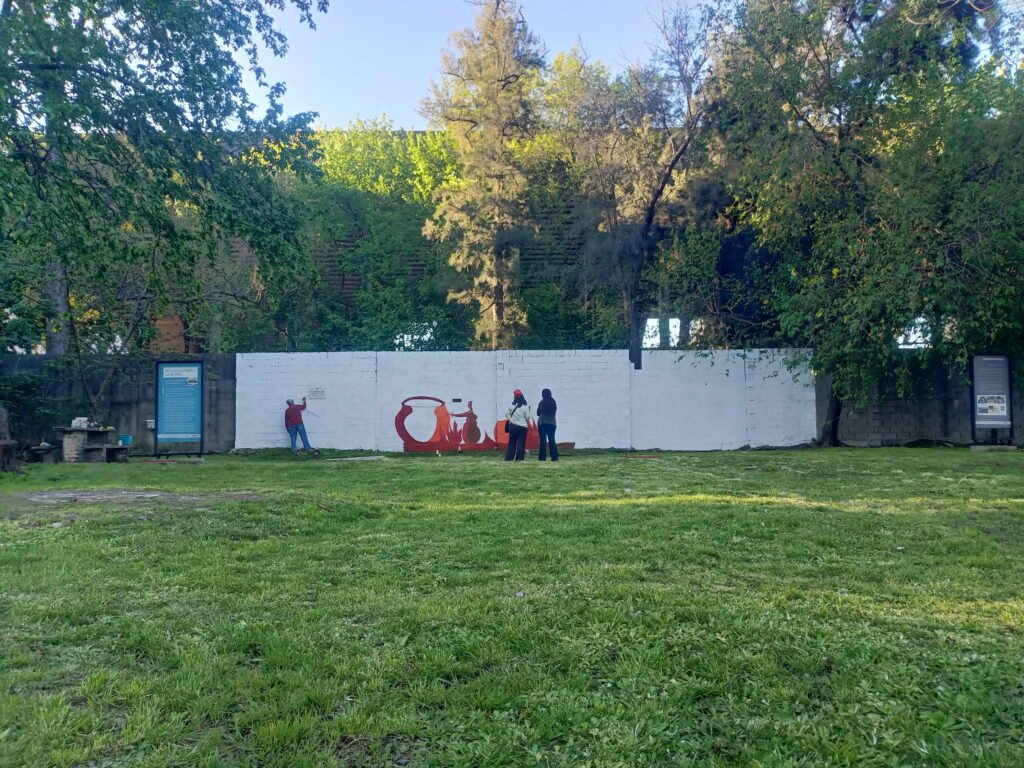
Location: Argentina, Buenos Aires, Parque Ribera Sur, Ancestral Site of La Noria
Credit: Giusy Pappalardo
Initiative: Belmont Forum CRAs (CCH)
Project: WRENCH
Story: I was walking along a stretch of the Matanza–Riachuelo River — the old course that resisted rectification. I am here to meet people I felt should be heard at the beginning of my research journey in Buenos Aires: members of Indigenous communities who survived colonial violence in the sixteenth century and,
centuries later, the brutality of military dictatorships. I feel honoured that they want to share their memories.
I am here to understand whether this river — one of the most contaminated in Latin America — is still perceived as heritage, and whether climate change
intensifies the toxicity affecting nearby communities. They guide me toward what appears to be one of the last public spaces still covered with trees in this
marginal part of Buenos Aires, at the border between the city and the province, where informal settlements coexist with high-rise buildings.
Parque Ribera Sur emerges in front of us.
Since the 1990s, it has been managed by the municipal workers’ union. Today, it appears as a spontaneous climate shelter, a place where working-class
families find shade and relief during heat waves. My Indigenous friends from the Pueblo Nación Querandí Comunidad Telomian Condic bring me to a community
meeting. We share an asado and begin to talk. For months, they have been planning a collective mural with local street artists. It will tell the story of their
ancestors and their living connection to the site of La Noria, near the old river course. It will include the river: a symbol of continuity, loss, and life despite
contamination. La Noria is where the first evidence of pre-Hispanic Indigenous settlements in Buenos Aires was found. The Old Riachuelo Channel preserves
part of those memories.
Months later, after seeing the first shapes of the mural emerge, I learn that the site of La Noria is at risk. The Government of Buenos Aires has decided to
transfer Parque Ribera Sur to private companies, through a decree approved without public notice. Perhaps this is another trajectory of neoliberal dynamics
that subtract urban spaces from the subaltern. Yet the people who live, paint, and care for this place are ready to defend it.
Within WRENCH, we decided to tell this story through a photograph, as perhaps the deepest meaning of transdisciplinary research is to amplify the voices of communities who struggle — mobilising memory to defend a place that matters as a climateidentity shelter, and much more.