
Location: Argentina, Chaco, Departamento Bermejo, Paraje Tres Horquetas
Credit: M. Florencia Fossa Riglos
Initiative: JPI-Climate/Belmont Forum 2015 (JPI – Belmont Forum)
Project: CLIMAX
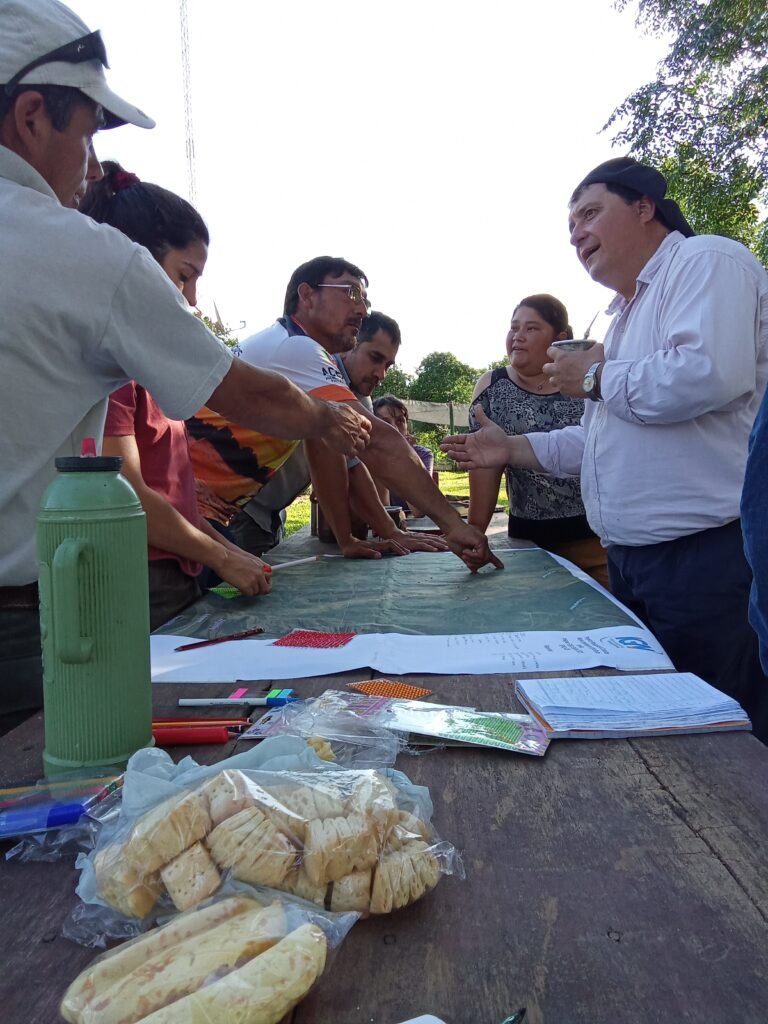
Story: This photograph captures a mapping workshop for flood risk management held on the farm of a family farmer in Tres Horquetas, a rural locality in Bermejo Department, Chaco Province, Argentina. The activity was part of the coproduction process carried out by the CLIMAX project between 2016 and 2023 (in collaboration with Argentina’s National Geographic Institute and Anticipando la Crecida project). Around twenty people participated in the mapping exercise, including academic actors (climatologists, anthropologists, a veterinarian, and an agronomist) from scientific institutions in Argentina and France, small and medium scale family farmers, and public policy decision makers involved in adapting the agricultural sector to climate change.
On the table are bizcochitos (a traditional snack) prepared by local women farmers and mate, a South American infusion with deep cultural significance.These shared food practices, the presence of children from the community and the willingness to collaborate within a framework of horizontal knowledge exchange, openness, and mutual learning, reflect how this activity was embedded within a network of socio-cognitive relationships built over the years of the CLIMAX project.
The photograph captures a revealing moment in the mapping process. Participants discuss and identify the locations of rivers, lagoons, homes, and flood-prone areas, helping one another interpret a landscape represented on a poster (in two dimensions) and viewed from an aerial perspective. As one farmer explained, “we are not used to seeing [the territory] from above,” highlighting the challenge of translating everyday spatial knowledge into cartographic language. This moment of uncertainty captures the very essence of the transdisciplinary knowledge co-production process. Memory, observation, scientific and technical knowledge, and place-based experience converge as participants build, through dialogue among different forms of knowledge, a shared understanding of hydroclimatic risk.
The photograph documents a moment of coproduction in which different forms of knowledge were able to interact under conditions of cognitive symmetry (Hernández et al., 2022). Farmers contributed detailed knowledge of river dynamics, flood histories, livestock management and everyday mobility, while researchers and technical experts provided cartographic, hydrological, climatological and social-organizational perspectives. It also shows risk management requires both scientific data on hydroclimatic regimes and socio-productive practices, as well as the participation of communities experiencing environmental change. The collaboration generated a multidimensional understanding of hydroclimatic risks and socio-territorial challenges, coproducing a map with socially relevant markers (informal bridges, shortcuts, natural indicators of river flood levels), which strengthened local capacities for climate change adaptation and informed public policy decision-making.