
Location: Osborne, Isle of Wight, England, United Kingdom
Credit: Shixin Zhao
Initiative: Belmont Forum CRAs (CCH 2023)
Project: Multiscale approaches and scalability within climate change-heritage risk assessments (SASCHA)
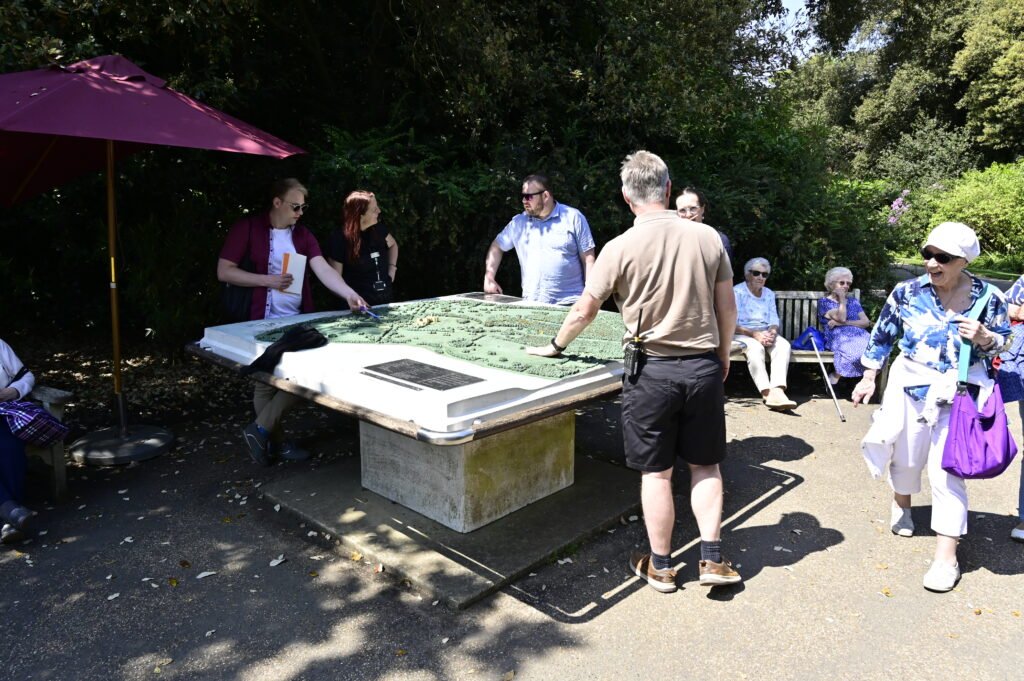
Story: At the entrance to Osborne, on the Isle of Wight, staff and members of the SASCHA research team gather around a tactile site model before walking through the historic estate. Osborne is one of the case study sites for SASCHA, a research project developing a Climate Profile: a simplified operational tool designed to quantify, compare, and communicate climate risks across heritage places at different scales. The SASCHA team brings together professionals in climate science, geographic modelling, data analysis, conservation, heritage management, and community engagement from the UK, the US, Italy, Norway, and beyond.
This photograph was taken during the SASCHA team’s first site visit to Osborne in May 2025. At this point, the visit was not only about seeing the site, but about learning how its buildings, collections, gardens, and wider landscape are connected in daily management. The site model became a useful starting point. It allowed staff and researchers to discuss Osborne as a whole place rather than as separate assets. From this shared view, climate risks could be connected to real heritage management decisions: how changing temperature, humidity, rainfall, wind, and seasonal patterns may affect historic interiors, outdoor collections, designed landscapes, visitor routes, and long-term maintenance.
SASCHA returned to Osborne in April 2026 for a second visit and workshop, where the Climate Profile was tested with stakeholders at different scales across the site. The aim was to see whether climate information could support practical adaptation planning for a complex heritage site, where decisions must balance conservation, access, landscape management, and future uncertainty.
The societal value of this work lies in making climate risk clearer and more usable for heritage decision-making. Rather than treating climate data as something separate from site management, the project brings researchers and heritage professionals together to translate climate information into forms that can support long-term care. In this sense, the photo captures an early moment in a wider transdisciplinary process: standing around a shared model of Osborne, the team begins to connect scientific evidence, site knowledge, and conservation practice into a common language for adaptation.