
Location: South Africa, Gauteng, Lehlakeng
Credit: Betsie le Roux
Initiative: Belmont Forum CRAs (ARC 2024)
Project: Co-creating Circular Sanitation Systems
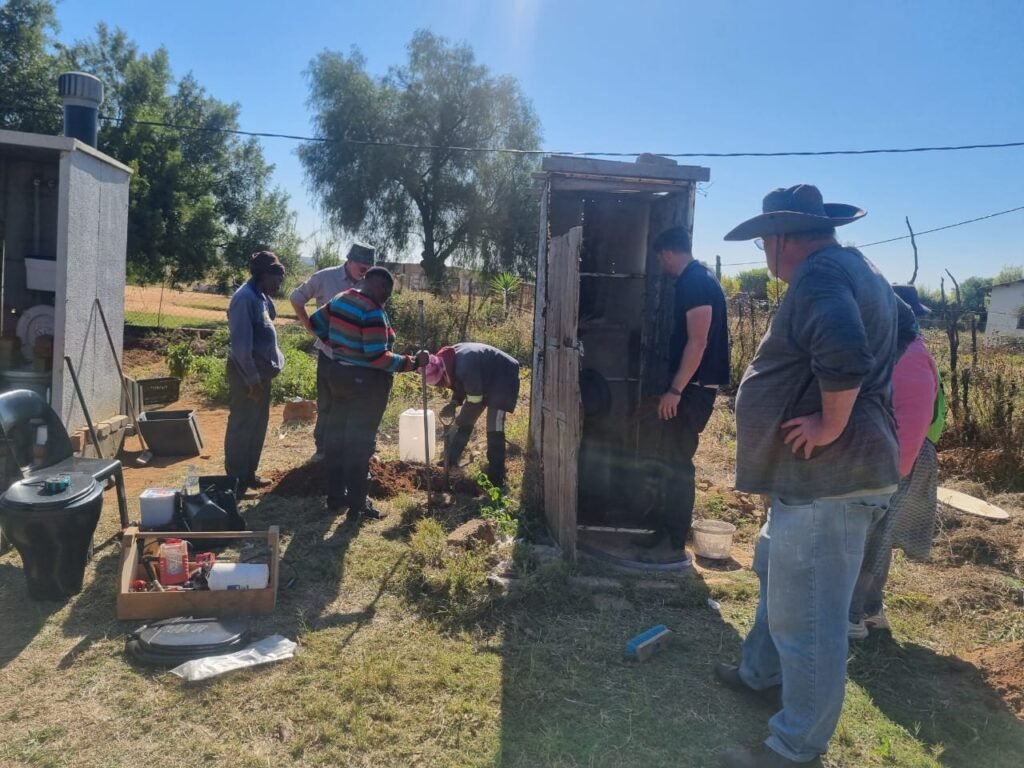
Story: This photograph captures a moment of collaborative problem-solving within the Co-Creating Circular Sanitation Project in Lehlakeng, South Africa. In an earlier intervention, the municipality provided residents with dry toilets intended to improve sanitation and reduce environmental impact. However, over time it became clear that the technology did not adequately align with local user practices, household needs, or the community’s capacity for maintenance.
As a result, many of the systems fell into disrepair. Overflowing pits, shallow installations, and poorly managed waste led to unsanitary conditions, including raw sewage exposure and persistent unpleasant odours. What was initially introduced as an improvement became, for many residents, a daily source of distress and indignity. Most residents resorted back to their unprotected pit latrine.
In response, our multidisciplinary project team—comprising engineers, natural scientists, and social scientists—worked closely with households in Lehlakeng to understand these failures. Rather than approaching the problem from a purely technical standpoint, the process centred on listening, observing, and co-designing solutions with the people most affected.
The scene shown in this image reflects one of these field engagements. The team is in discussion with residents, collectively exploring possible design modifications of the dry toilet and the pit latrine to better suit local conditions and preferences. At the same time, practical work is underway, including the careful digging of a new hole intended for a urine capture container—an incremental but important step in adapting the system to real-world use.
This moment illustrates the shift from top-down infrastructure delivery to participatory, adaptive design. It highlights sanitation not only as a technical challenge, but as a social and ecological system that must evolve through continuous dialogue between technology and community practice.
An effective, locally-appropriate sanitation solution in South Africa can significantly improve public health by reducing exposure to unsafe waste and waterborne diseases, while also restoring dignity and safety in everyday life. It can also strengthen environmental protection and support more sustainable, community-centred approaches to infrastructure delivery.