
Location: Wamena, Highlands of Papua, Indonesia
Credit: Yulia Sugandi, Center for Transdisciplinary & Sustainability Sciences IPB University. Image copyright (c) Papua Democratic Institute
Initiative: Research led by the Papua Democratic Institute (Agroecology Fund)
Project: Local Food System Resilience in Papua
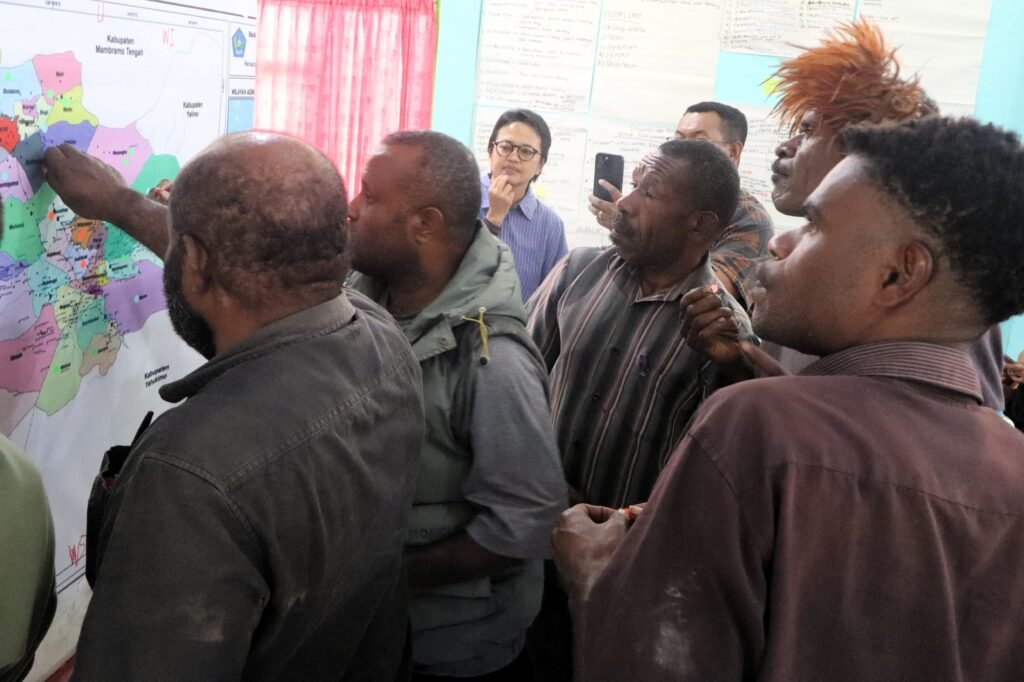
Story: This image illustrates the practice of regenerative listening within a transdisciplinary agroecology study conducted in the highlands of Papua, Indonesia. The research team engaged with Indigenous farmers and other local knowledge holders to better understand place-based values, socio ecological relations, and community priorities that informed the selection of research sites.
Regenerative listening is an essential capacity in transdisciplinary research. It goes beyond conventional forms of consultation by cultivating epistemic humility, attentiveness, and openness to multiple ways of knowing. Through this practice, researchers can formulate research questions and variables that are not only scientifically rigorous but also socially meaningful and locally grounded.
In this study, regenerative listening formed the initial phase of the research process. It brought together diverse actors including government representatives, farmers, church leaders, Indigenous communities, women, and youth in a shared process of research design. Rather than treating local knowledge as supplementary, the approach positioned it as foundational to shaping the research agenda from the outset.
By aligning scientific inquiry with lived experience and Indigenous knowledge systems, the process enabled knowledge co creation and strengthened community agency. Local actors were not merely informants but active partners in defining what is worth studying, why it matters, and how it should be approached. This shift reconfigures research relationships toward greater reciprocity and shared responsibility.
The transdisciplinary research team itself reflected this commitment to plurality, bringing together scholars and practitioners from the natural sciences, social sciences, political studies, and Indigenous communities, some of whom are also farmers. This diversity was not only disciplinary but also experiential, allowing multiple perspectives to shape both interpretation and practice.
Transdisciplinarity in this sense is fundamentally relational. It unfolds through ongoing reflection and dialogue among all participants within the research team and between researchers and local knowledge holders. Such reflexivity enables continuous learning, mutual adjustment, and ethical engagement with complexity.
Ultimately, this relational and reflexive practice of research fosters deeper integration between science, society, and policy. It also opens possibilities for systemic transformation by challenging hierarchical knowledge structures and supporting more inclusive and situated forms of understanding and action.