
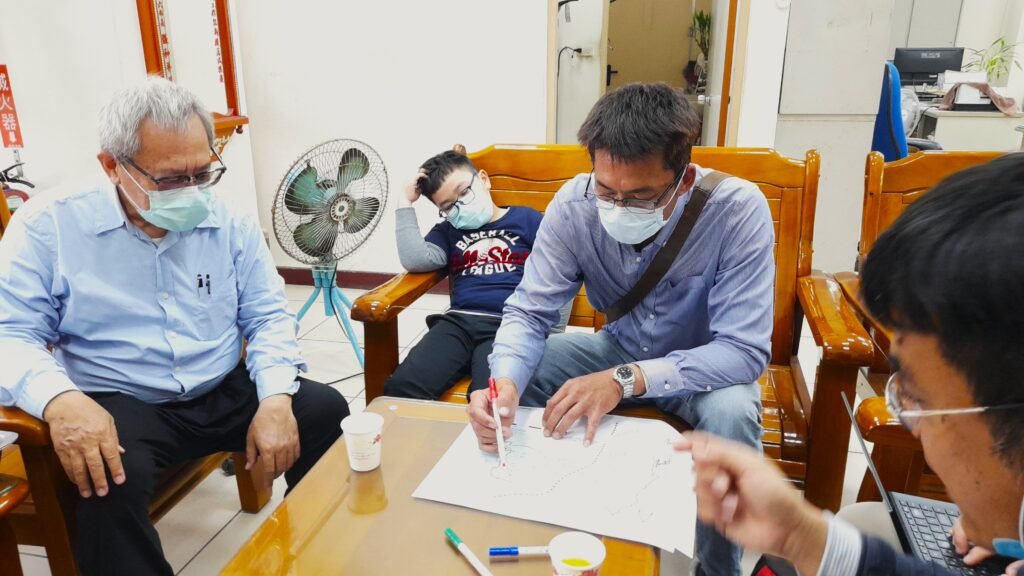
Location: Taiwan, Yunlin county
Credit: Jean-Daniel Rinaudo
Initiative: Belmont Forum CRAs (SOILS 2020)
Project: INCLUSIVE GROUNDWATER
Story: This photo was taken in February 2023 during a survey conducted among local stakeholders in Yunlin, on Taiwan’s west coast. The person being interviewed (facing the camera) is the manager of a drilling company. The researchers asked him to explain his understanding of the land subsidence phenomenon that severely affects the region. They invited him to illustrate his explanations with freehand drawings depicting the various aquifer layers, groundwater flows, sediment compaction zones, as well as the socio-economic factors underlying the phenomenon and its consequences. The conversation is rich and lengthy, much to the despair of his young son in the background. A local representative of an irrigation association (left) watches attentively, waiting for his turn to draw.
The use of drawing facilitated knowledge sharing and dialogue between academic and local expertise. The local knowledge gathered during this survey gradually contributed to the development of a holistic understanding of the problem. It revealed that the physical processes involved—overexploitation of aquifers and sediment compaction—are partly rooted in inconsistencies among public policies related to water management, land-use planning, agriculture, and food security. Local actors thus helped scientists broaden their understanding of an issue they had initially approached primarily through the lens of earth sciences. Together, they co-constructed a systemic representation of land subsidence, providing a tangible example of the hybridization of local and academic knowledge.
The static nature of the photograph unfortunately does not capture the difficulties inherent in this process of co-constructing hybrid knowledge. In Taiwan, as in many other societies, social hierarchies can hinder dialogue between laypeople and scientists. The irrigation association representative, waiting for his turn, feels intimidated by the university professor. Who is he to answer the questions of such an eminent scholar, who has spent so many years in school? The professor, too, is somewhat uncomfortable with the idea of reversing roles. Fortunately, there is a French researcher behind the camera, unfamiliar with local social codes, whose awkwardness helps ease the interaction and smooth the interview process.