
Location: South Africa, Eastern Cape, Bokness River, Ndlambe Municipality, Sarah Baartman District
Credit: Marco Worship
Initiative: Not part of Belmont (Department of Forestry, Fisheries and the Environment, South African Government)
Project: Integrated, transdisciplinary research linking environmental processes, human systems, and real-world decisions.
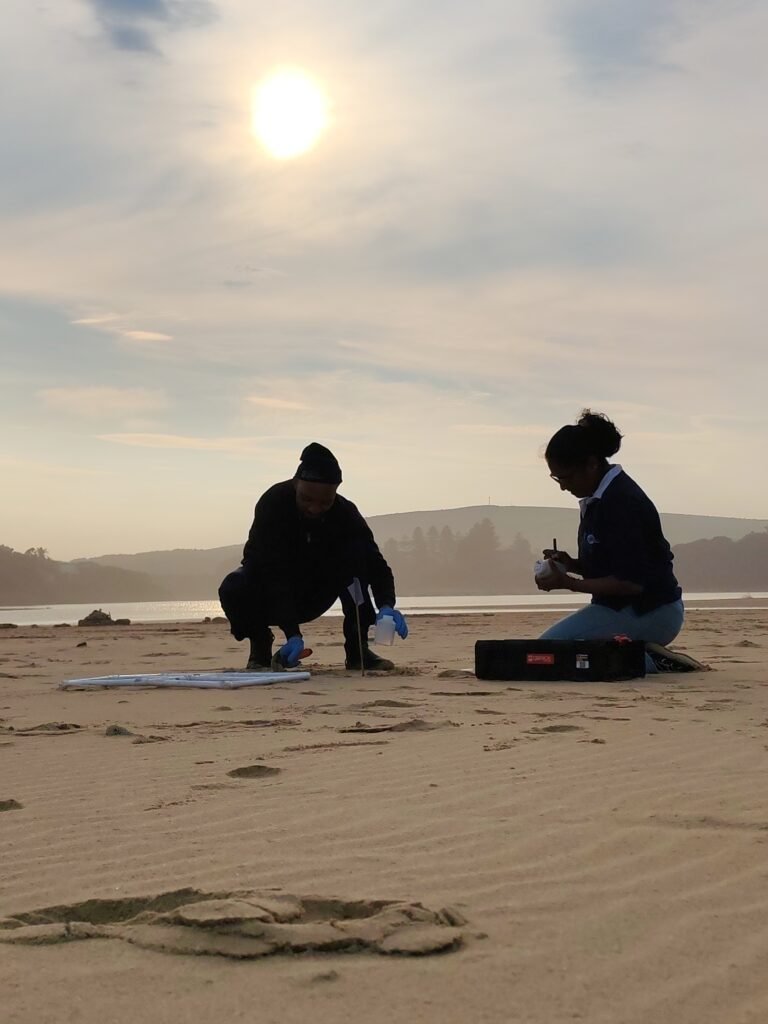
Story: On a quiet stretch of shoreline in South Africa’s Eastern Cape, within the rural Ndlambe municipality of the Sarah Baartman District, the beach appears clean, almost untouched. Yet beneath the surface lies a more complex story, one that cannot be seen without careful, systematic observation. This image captures field sampling for microplastics, but the work extends far beyond that. The protocol used here was designed to simultaneously measure macro-, meso-, and micro-plastics within a single grid, linking visible pollution to the fragments that persist long after larger items break down. In this way, the grid becomes more than a sampling tool; it becomes a bridge across scales. These sites are not chosen at random. Beaches are strategically selected along river mouths within a largely rural coastal district, where communities experience very different waste management realities, from limited services to more formalised systems. By design, each sample reflects not only what is present on the shore, but the effectiveness of upstream decisions, how waste is managed, how materials move through landscapes, and how they ultimately reach the ocean. What is measured here is therefore not just pollution, but the outcome of interconnected human and environmental systems. The setting itself reinforces this connection. The ocean lies just beyond, the river meets the sea nearby, and the surrounding landscape reflects a mix of natural ecosystems and dispersed human settlements typical of rural South African coastlines. Within this single frame, local action intersects with larger global processes. The work speaks directly to the source-to-sea continuum: a recognition that marine pollution does not begin at the shoreline, but is shaped by choices made far inland. By standardising methods across sites, the data generated here contributes to a broader effort to understand, compare, and ultimately manage plastic pollution in a consistent and policy-relevant way. What appears as a quiet moment of sampling is, in reality, part of a much larger system of observation and understanding—one that connects communities, rivers, and oceans. Through this lens, the beach becomes not just a place, but a point of evidence in a global environmental challenge.