
Location: Ethiopia, Amhara Region, Megedel Watershade, Bahir Dar Zuria
Credit: Getasew
Initiative: OEAD (OeAD)
Project: Establishing Transformative Learning, Research, and Community Outreach and Capacities in Agroecology at Bahir Dar University, Ethiopia | LINK
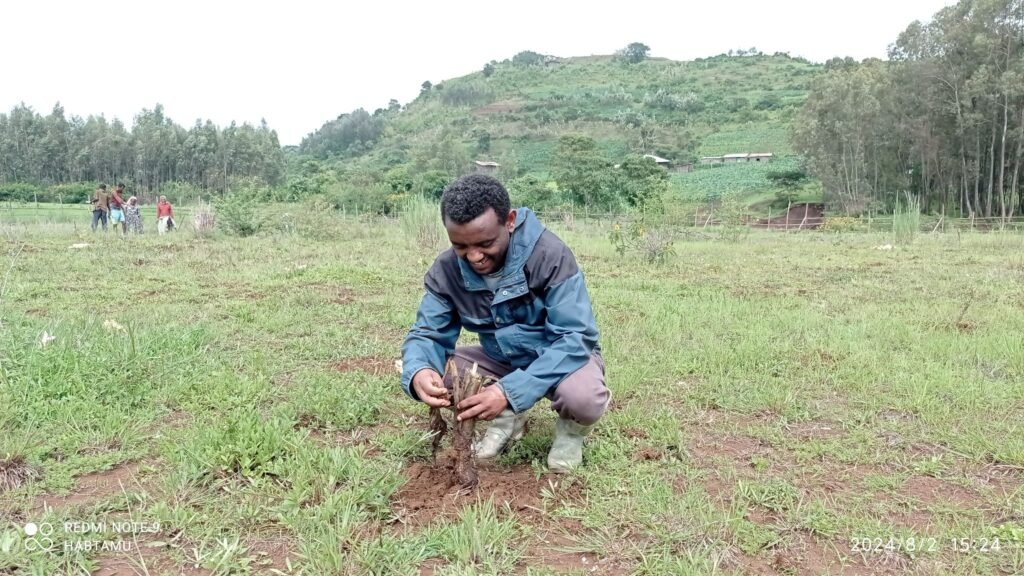
Story: This photo captures a moment of commitment, resilience, and service during the implementation of the APPEAR LINK P351 Project in rural Ethiopia. It shows Dr. Habtamu Assaye, a project member, actively planting Enset (Ensete ventricosum)in the Amhara Region, specifically in the Mogedel Watershed of northern Ethiopia. The image reflects how the project translated its food security goals into real, field-level action.
Enset is well known as a dependable and locally important crop in southern Ethiopia; however, in this project activity, enset planting was introduced to northern communities as an alternative for food security. In this case, the enset plants were brought from Monogenetic Agricultural College under Hawassa University and were then established through plantation activities in the project area. By relocating and growing this crop beyond its traditional region, the project aimed to strengthen household resilience and expand locally appropriate livelihood and food security pathways.
The background shows other community members also participating in the plantation work, emphasizing the shared nature of the activity. This participation is crucial: it supports local ownership, encourages learning through hands-on involvement, and helps ensure that Enset planting is not treated as a one-time activity but as part of a wider effort to support sustainable agricultural practices and long-term food security.
The APPEAR LINK P351 Project’s aim was to share experience and support vulnerable communities through livelihood and food security–related activities. In the Mogedel Watershed area, where households face ongoing constraints and risk to food availability, establishing Enset plantations represents a practical step toward improving food security outcomes. Enset planting supports diversification of household production and strengthens coping capacity during periods when other sources of food may be limited.
Beyond the individual action shown in the foreground, the photo represents the broader reality of rural development work: communities and project teams must work directly with people, in the field, in order to bridge gaps in opportunity and access. The careful planting of Enset symbolizes more than agricultural labor—it reflects the effort to create lasting, inclusive change by building resilience through locally relevant interventions.
The societal impact of initiatives like this is significant. Supporting Enset plantation helps contribute to improved household resilience, more stable access to food, and greater community empowerment. Therefore, this photo tells a story not only of planting and participation but also of hope, dedication, and shared responsibility in strengthening food security in underserved rural communities of northern Ethiopia.