
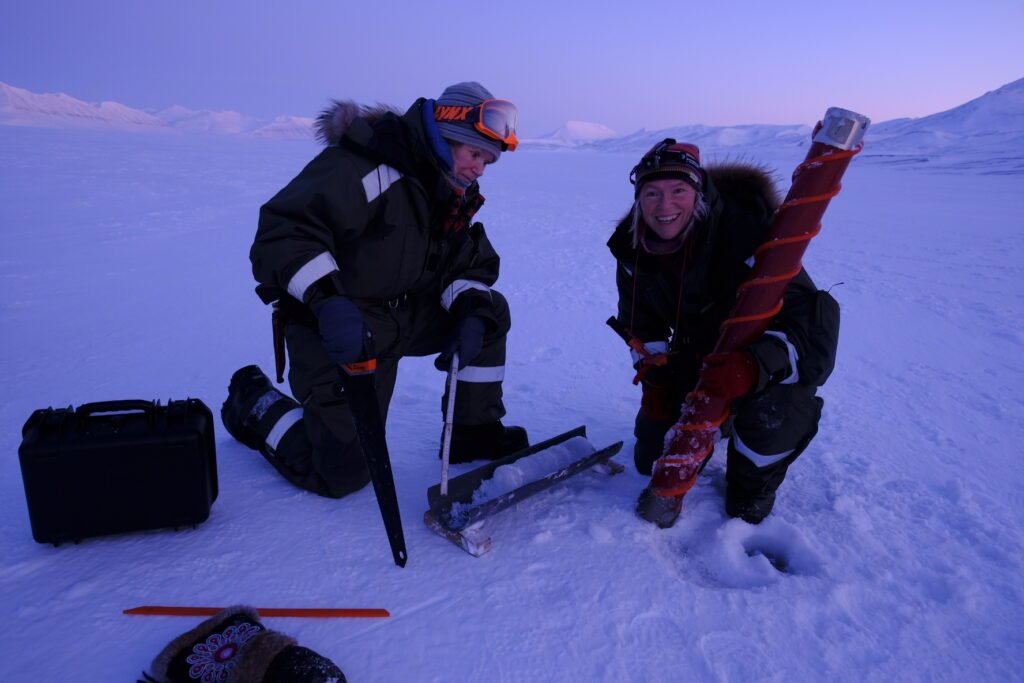
Location: Bamsebu, Van Keulen fjord, Svalbard, Norwegian Arctic
Credit: Hilde Fålun Strøm, Hearts in the ice
Initiative: Belmont Forum CRAs (2017-2018 Belmont Forum and BiodivERsAjoint call)
Project: Hearts in the ice
Story:
This photograph, taken on February 22, 2020, shows my Hearts in the Ice expedition partner and me collecting ice core samples for Professor Janne Søreide at the University Centre in Svalbard (UNIS). At the time, COVID-19 was beginning to spread globally, and fieldwork was becoming increasingly difficult for researchers. Meanwhile, we were living in Bamsebu, a remote trapping cabin in South Spitsbergen National Park, accessible only a few months each year and far beyond the reach of conventional field campaigns.
For most scientists, visiting this region once during a field season is considered fortunate. Yet during our 19-month overwintering expedition, spanning 2020 and 2021, no researchers were able to reach the area. Our continuous presence transformed Hearts in the Ice into a unique citizen science platform and enabled an extraordinary collaboration with Professor Janne Søreide and UNIS.
The partnership proved invaluable to both sides. Researchers gained access to otherwise unattainable observations and samples, while we became active contributors to climate science. In addition to supporting UNIS, we collected data and observations for NASA, the Norwegian Polar Institute, and five other scientific institutions, contributing to a total of seven ongoing research projects.
This collaboration perfectly reflected the mission of Hearts in the Ice: to build bridges between scientists and society, foster engagement with climate research, and share the love and wonder of the Arctic with people around the world. Through satellite communications, we connected with hundreds of thousands of followers and engaged more than 104,000 schoolchildren through monthly virtual conversations featuring experts from around the world.
Together with Professor Janne Søreide and our scientific partners, we demonstrated that meaningful research does not only happen during short field campaigns. By combining scientific expertise with dedication, communication, and citizen participation, we showed that even from one of the most inaccessible places on Earth, it is possible to generate knowledge with global relevance and inspire people to understand why changes in the Arctic matter to us all.