
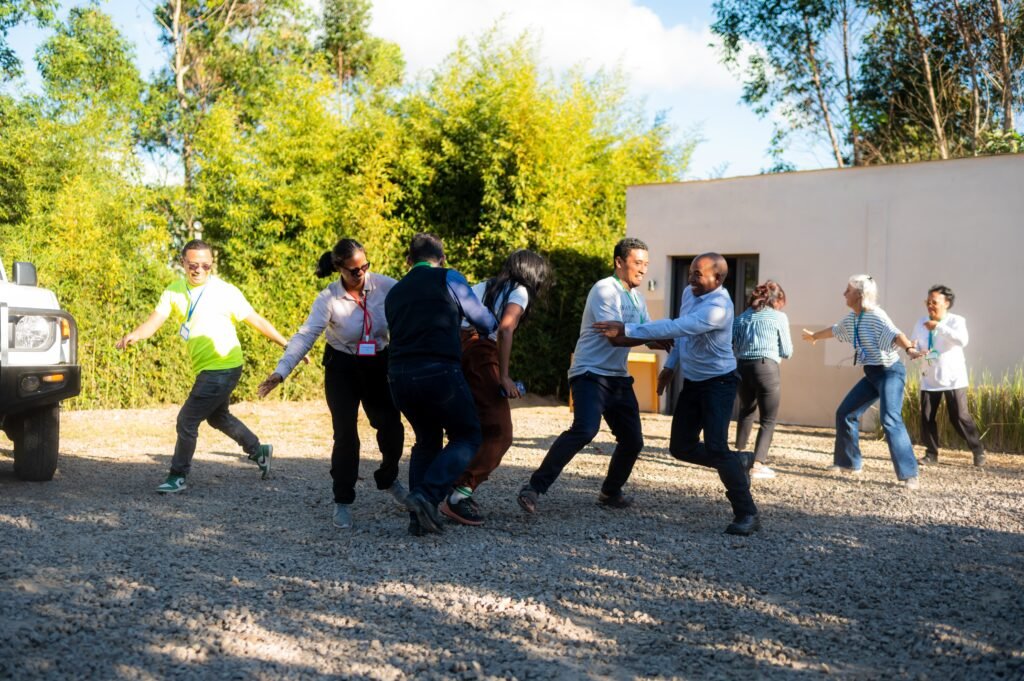
Location: Andasibe, Madagascar
Credit: Liantsoa Ratsimbazafy (professional photograher hired by the project)
Initiative: Belmont Forum CRAs (MIGRATION 2022)
Project: Climate Hazards and Migration in Madagascar: Towards an Integrated Monitoring and Modeling for Mitigation and Adaptation (CHAIN)
Story: This photograph was taken during the CHAIN (Climate Hazards and Migration in Madagascar) stakeholder workshop held in Andasibe, Madagascar, in May 2026. At first glance, the scene appears playful: participants are running, laughing, and interacting outdoors. Yet behind this moment lies a serious effort to understand one of Madagascar’s most pressing development challenges: how climate hazards, migration, food security, and environmental change interact to shape people’s lives.
The participants in this image include researchers, humanitarian practitioners, government representatives, conservation professionals, development organisations, and policy actors. They came together through the CHAIN project, a Belmont Forum-funded initiative that seeks to improve understanding of how droughts, cyclones, environmental change, and mobility affect vulnerable populations across Madagascar.
The exercise shown here is called the “Protector Game”, an interactive activity designed to introduce key concepts behind agent-based modelling. Rather than presenting a computer model through technical equations or software, participants physically experience how individual decisions, cooperation, uncertainty, and social interactions can collectively generate broader system-level outcomes. The exercise encourages participants to move beyond disciplinary perspectives and engage directly with the complexity that models attempt to represent.
This moment captures an important aspect of transdisciplinary research. Instead of treating stakeholders as passive recipients of scientific findings, the workshop was designed around the co-production of knowledge. Humanitarian organisations contributed operational experience from disaster response. Government representatives brought policy perspectives. Researchers contributed empirical evidence and modelling approaches. Through discussion and participation, these different forms of knowledge were brought together to critically examine assumptions, identify priorities, and shape future research directions.
The stakes of these discussions are very real. Madagascar faces recurrent droughts, cyclones, food insecurity, environmental degradation, and growing pressures on livelihoods. Policymakers and practitioners must make difficult decisions about disaster preparedness, social protection, migration, and resilience-building under conditions of uncertainty. The CHAIN project uses empirical research, stakeholder engagement, and agent-based modelling to explore how different policy choices may influence future outcomes and to identify pathways toward greater resilience.
More than a game, this photograph illustrates a broader vision of science as a collaborative process, one in which researchers, practitioners, and decision-makers learn together, challenge assumptions together, and jointly develop the knowledge needed to address complex sustainability challenges in Madagascar and beyond.