
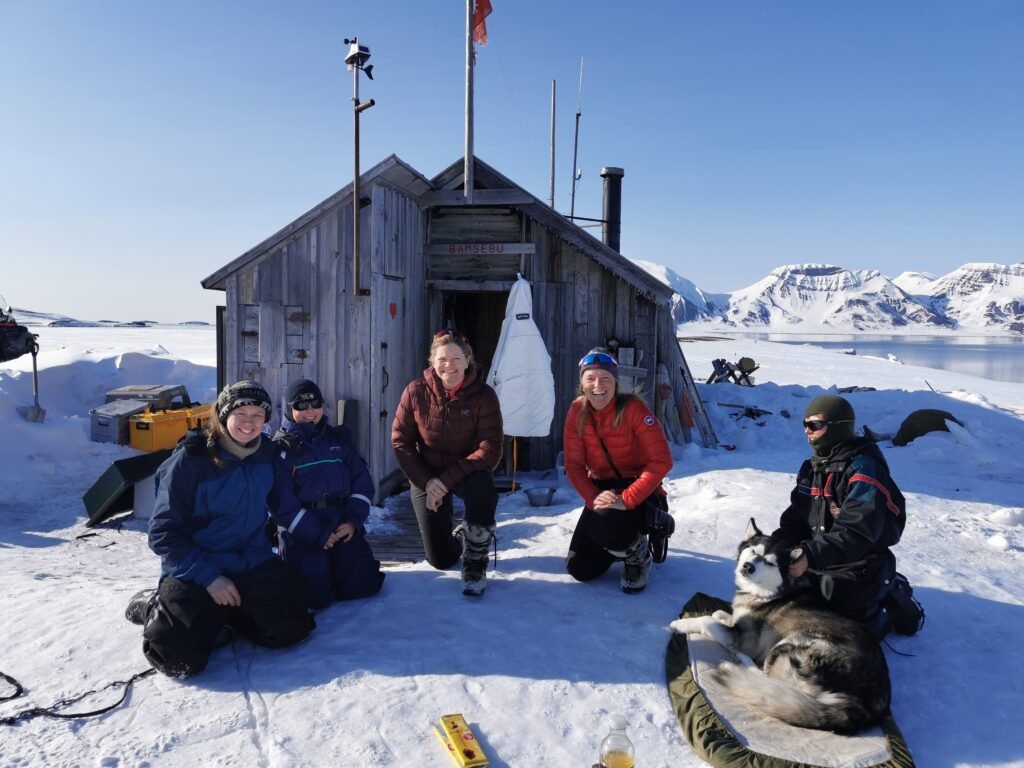
Location: High Arctic, South Spitsbergen, Van Keulen fjord, Bamsebu
Credit: Hearts in the ice, Hilde Fålun Strøm
Initiative: Belmont Forum CRAs (2017-2018 Belmont Forum and BiodivERsA joint call)
Project: Hearts in the ice
Story: Science Beyond the Field Season
This photograph captures Professor Janne Søreide from the University Centre in Svalbard (UNIS) together with me outside Bamsebu in March 2021, marking the end of an extraordinary collaboration between academia and citizen science.
Bamsebu, an uninsulated trapping cabin built in 1930 for beluga hunting, lies deep within South Spitsbergen National Park. Without electricity or running water, and accessible only a few months each year, it is one of the most remote places in the Norwegian Arctic. Yet for 19 months, through the Hearts in the Ice expedition (2019–2021), it became a unique platform for climate research and science communication.
What made this collaboration with Professor Janne Søreide and UNIS exceptional was continuity. While scientists are typically limited to short field seasons, we lived year-round in this inaccessible ecosystem, becoming “extreme citizen scientists.” Together with UNIS, we collected ice core samples and contributed valuable observations and measurements to seven ongoing climate research projects.
Professor Søreide recognized that our continuous presence created a rare opportunity to extend the reach of science beyond conventional expeditions. The partnership demonstrated how researchers and dedicated citizens can work together to gather meaningful data from places that are difficult to access and monitor.
The image also represents a historic moment. During our first winter, Hearts in the Ice became the first all-female team in Norwegian Arctic history to overwinter without men. But more importantly, it symbolizes the trust, collaboration, and shared curiosity that connected scientific expertise with lived experience in the field.
Through satellite communications, our work reached hundreds of thousands of followers worldwide. We also engaged 104,000 schoolchildren through monthly virtual conversations, bringing leading experts—including Dr. Jane Goodall—into classrooms around the globe.
This image is a reminder that biodiversity and climate research depend not only on technology and institutions, but also on human relationships, perseverance, and the willingness to build bridges between science and society. Together with Professor Janne Søreide and UNIS, we showed that even from a small cabin at the edge of the world, global impact is possible.