
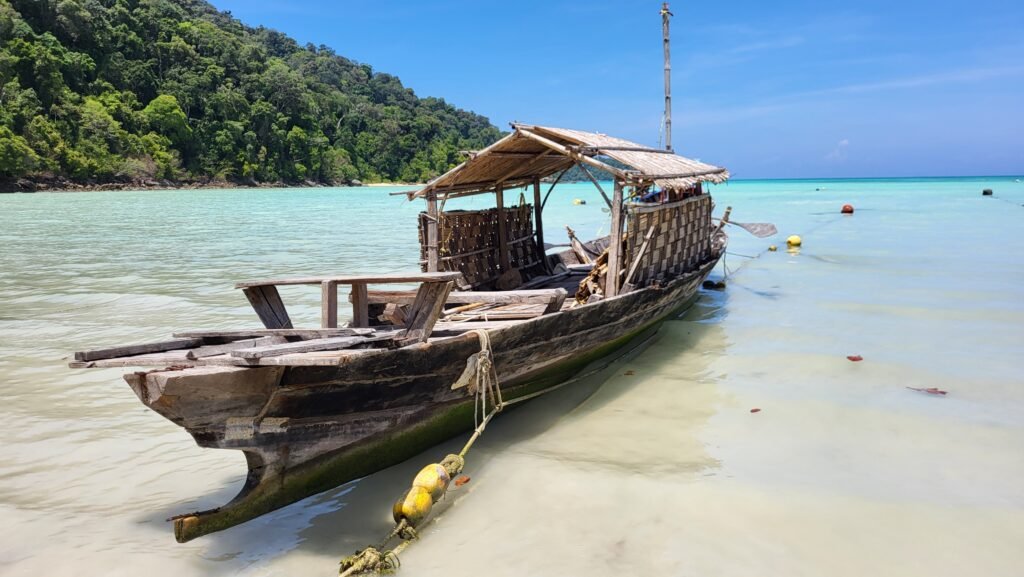
Location: Thailand, Ko Surin (Island)
Credit: Simon Bunchuay-Peth
Initiative: Belmont Forum CRAs (CCH 2023)
Project: Cultural Heritage in Motion (CuHeMo)
Story: For generations, the Moken of the Andaman Sea lived on water. Their home was the kabang, a handcrafted wooden boat large enough for an entire family, built from the wood of specific trees whose location and properties were passed down through generations of oral knowledge. Moken children learned to swim and dive before they could walk. Families spent months at sea, following the fish and the winds, coming ashore only when the monsoon made the waters too dangerous.
Today, there is only one kabang left. This one. It is maintained by an elderly man on Surin Island, Thailand, and it will likely not be replaced. The trees whose timber was used to build kabangs are now protected inside a Marine National Park, the same park that covers the Moken’s ancestral sea territory and has severely restricted their right to fishing, move, and live as they always had. The Moken were settled. Their nomadic maritime life has come to an end.
What looks, at first glance, like a picturesque scene, a wooden boat in turquoise water, jungle hills behind, blue sky above, is in fact a portrait of a cultural heritage at its final moment.
And now a new pressure compounds the old ones. Sea level rise and increasing coastal erosion are flooding the stilt-house villages where the Moken were (re)located. The sea they were told to leave is reclaiming the land they were told to stay on. They cannot return to the water where they once lived, and the land is no longer safe either. The forest behind their houses was protected.
This photograph was taken during fieldwork for CuHeMo (Cultural Heritage in Motion), a transdisciplinary research project funded under the Belmont Forum Collaborative Research Action on Climate and Cultural Heritage, documenting how indigenous mobile communities navigate the convergence of sedentarization, conservation policy, and climate change.